
Calibration
How our AI scoring works
A number is only worth the method behind it. This page is the method: what the scoring was tested against, how many times, what counted as a hit, and the band where it stops working.
What it was measured against
Officially rated CELPIP sample responses — answers that already carry a level assigned by the exam’s own raters. Our scoring never sees that level; it is compared afterwards.
Speaking — 110 scored calls
22 rated samples, each scored 5 times, from the published audio rather than transcripts. The run covered 2 of the 8 Speaking tasks: Task 1 and Task 8.
Writing — 108 scored calls
36 rated samples, each scored 3 times, with anchors at every level in the set.
When
August 2026, on the model in production that month. A new model means a new measurement, not an inherited one.
Scoring the same answer several times is deliberate: the model is not deterministic, so one call per sample would measure luck. Across five calls on one Speaking answer the estimates differed by 0.489 of a band on average.
What counts as a hit
Within one band means the estimate is the official level, or one CLB level either side. Two levels away is a miss. That is the looser definition and also the flattering one, so it is stated here rather than buried.
The numbers, both halves
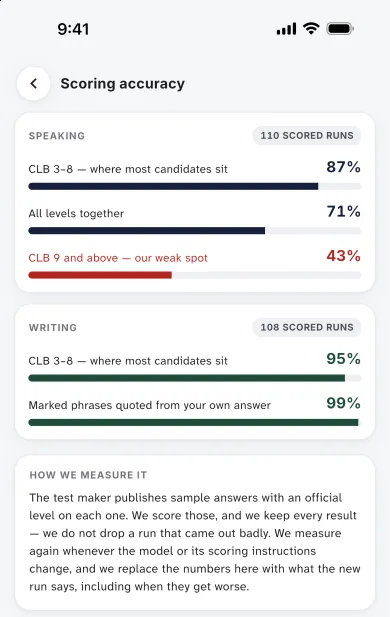
| What was measured | Result | Calls |
|---|---|---|
| Speaking, official CLB 3–8, within one band | 87% | 70 |
| Speaking, official CLB 9 and above, within one band | 43% | 40 |
| Speaking, all levels together, within one band | 71% | 110 |
| Writing, official CLB 3–8, within one band | 95% | 108 |
| Writing, quote fidelity — a marked phrase really is in your answer | 99% | 108 |
The 43% is 17 of 40 calls, which is 42.5%; we publish it rounded up and print the raw count so nobody meets the difference by surprise. Overscoring across the Speaking run was 7% — the rest of the error runs strict rather than generous.
Why nothing above CLB 9 is printed as a single number
Because of the 43%. Up there the estimate misses the band more often than it hits it, and a bare number would claim a precision we have measured ourselves not to have. So every report shows a range, the app’s own test suite enforces it on the screen, and this page and the score calculator do the same. If you are already scoring 9 or 10, treat the estimate as a rough sanity check.
The four dimensions
A report scores four dimensions separately, under the names the published CELPIP rubric uses:
- Content & coherence
- Vocabulary
- Listenability on a spoken answer, Readability on a written one
- Task fulfillment
Using the published names is not the same as reproducing the official weighting, and we claim nothing about the second. The weakest dimension is marked, and the two fix-first instructions attach to it.
Why quote fidelity is on the list
A Writing report marks the phrase that cost you and the phrase that would replace it. If the marker invented that phrase the whole report would be worthless, so it is measured too: 99% of marked phrases appear in the candidate’s own answer word for word.
What we have not measured
Writing above CLB 8. The 95% covers the core band; there is no upper-band Writing figure on this site.
Six of the eight Speaking tasks. The run used Task 1 and Task 8. The other six use the same rubric and the same model, but they were not part of this measurement.
What happens on test day. These are estimates from a practice tool. An official CELPIP result takes 2 to 4 business days and comes from the test provider.